Consequences of the Station Fire
September 27th, 2009
Podcast: Download (Duration: 33:20 — 30.5MB)
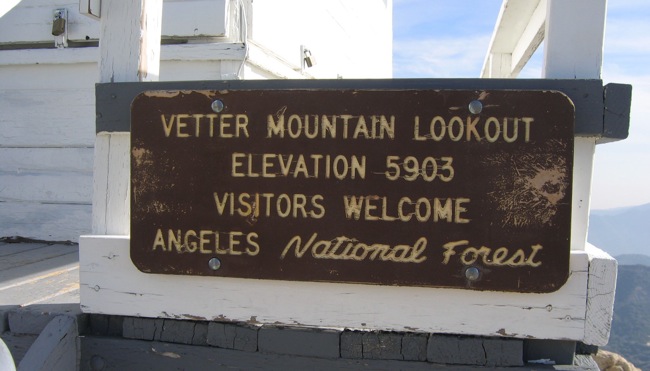
Vetter Mountain Lookout, 1937 – 2009
Wildland firefighter and fire ecologist Rick Halsey returns to Treehuggers International to discuss the impact of the Station Fire, burning in the San Gabriel Mountains.
The founder and director of the Escondido-based California Chaparral Institute, Rick is also a member of the San Diego Regional Fire Safety Forum, and the author of the book Fire, Chaparral, and Survival In Southern California.
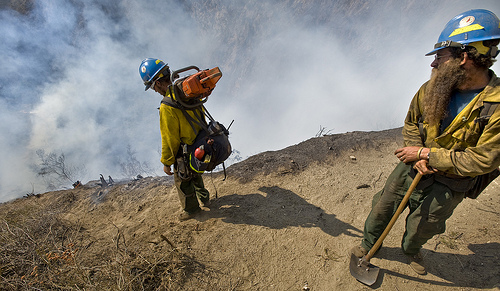
Fighting fire on the steep slopes of the San Gabriels.
With major wildfires having blackened scores of acres in the Golden State this year in the Santa Cruz Mountains, Gold Country and the Sierra foothills, and the counties of Santa Barbara (four times in the last 12 months), Mendocino, Sonoma, Sacramento, and elsewhere, it seems every season has become fire season in California.
But few in the Southland were ready for the size and duration of the fire which swept down the canyons into Altadena, La Cañada Flintridge, and Tujunga. Ultimately the Station Fire set a notorious record, as the largest wildfire ever in Los Angeles County.
After claiming two lives, destroying over 80 homes, and burning through 154,000 acres of the Angeles National Forest, the Station Fire is at last nearly under control, and conservationists, fire professionals, outdoor recreationsists and political leaders are beginning to take stock of what was lost and what can be done.
Of concern to Treehuggers International are the dozens of prized outdoor recreation spots in the Angeles National Forest now consigned to memory, obliterated in the furnace of the wildfire. Locales like the famous Vetter Mountain Lookout served as havens for generations of Southern Californians eager to recharge in the “good tidings” of the San Gabriels’ chaparral-covered slopes, meadows, streams, forests, and Mojave Desert and L.A. Basin views.
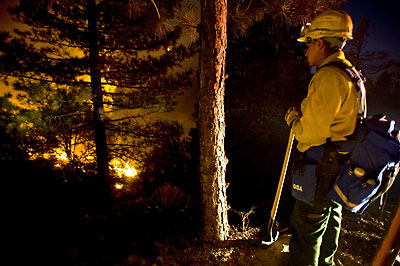
Lonely watch on the fire line.
While the Station Fire did not make major penetrations into the San Gabriel high country, thousands of acres of old-growth chaparral were lost.
As is the case with the frequent fire pattern currently at work in Southern California, the way has been cleared for aggressive, non-native grasses and other plants to move in, thereby increasing the risk of fire in the near term, and making it more more difficult for the natural ecosystem of the region to re-establish itself.
As fires become more frequent in our ongoing drought, it seems California’s chaparral wildlands are burning themselves into oblivion.
But is all of this a calamity? Are even more firebreaks and brush clearing in the backcounty necessary to avoid another disaster? Should these fires simply be allowed to burn themselves out?
Rick Halsey explains why the solutions to avoiding disaster in California’s year-round fire season come first with the understanding that large fires are not unusual for our environment; the frequency is the problem. Fire is a natural, normal part of western “dry forest” ecosystems, but humans are causing far too many fires for even nature to handle.
Wise management and an appreciation for the Mediterranean climate of Southern California is the cornerstone to respecting the region’s wild side, and understanding fire is a natural, normal part of California’s ecosystems.
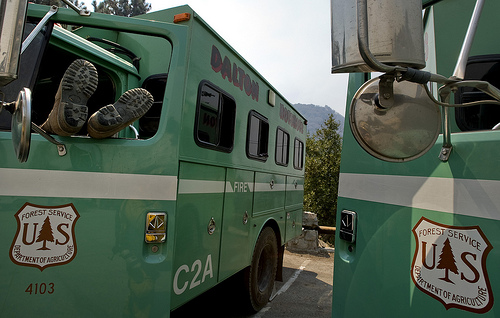
A member of the Dalton Hotshots grabs a few minutes of sleep.
More about this post at:
- California Chaparral Institute
- San Diego Regional Fire Safety Forum
- Angeles National Forest Fire Lookout Association
- Wikipedia, Mediterranean climate
- Charles Phillip White Foundation, announcement of Vetter Lookout destruction
- Fire, Chaparral, and Survival In Southern California
- Angry Fire Rolls Across 100,000 Acres (CNN; 8/31/09)
- Station Fire Is Largest In L.A. County’s Modern History (Los Angeles Times, 9/2/09)
- Station Fire Consumes 154,655 Acres, Moves Through San Gabriel Wilderness (Los Angeles Times, 9/4/09)
- L.A.’s Nature Haven, Reduced to Wasteland (Los Angeles Times, 9/6/09)
- All He Is Saying Is Give Brush A Chance, Rick Halsey profile (Los Angeles Times, 11/26/08)